
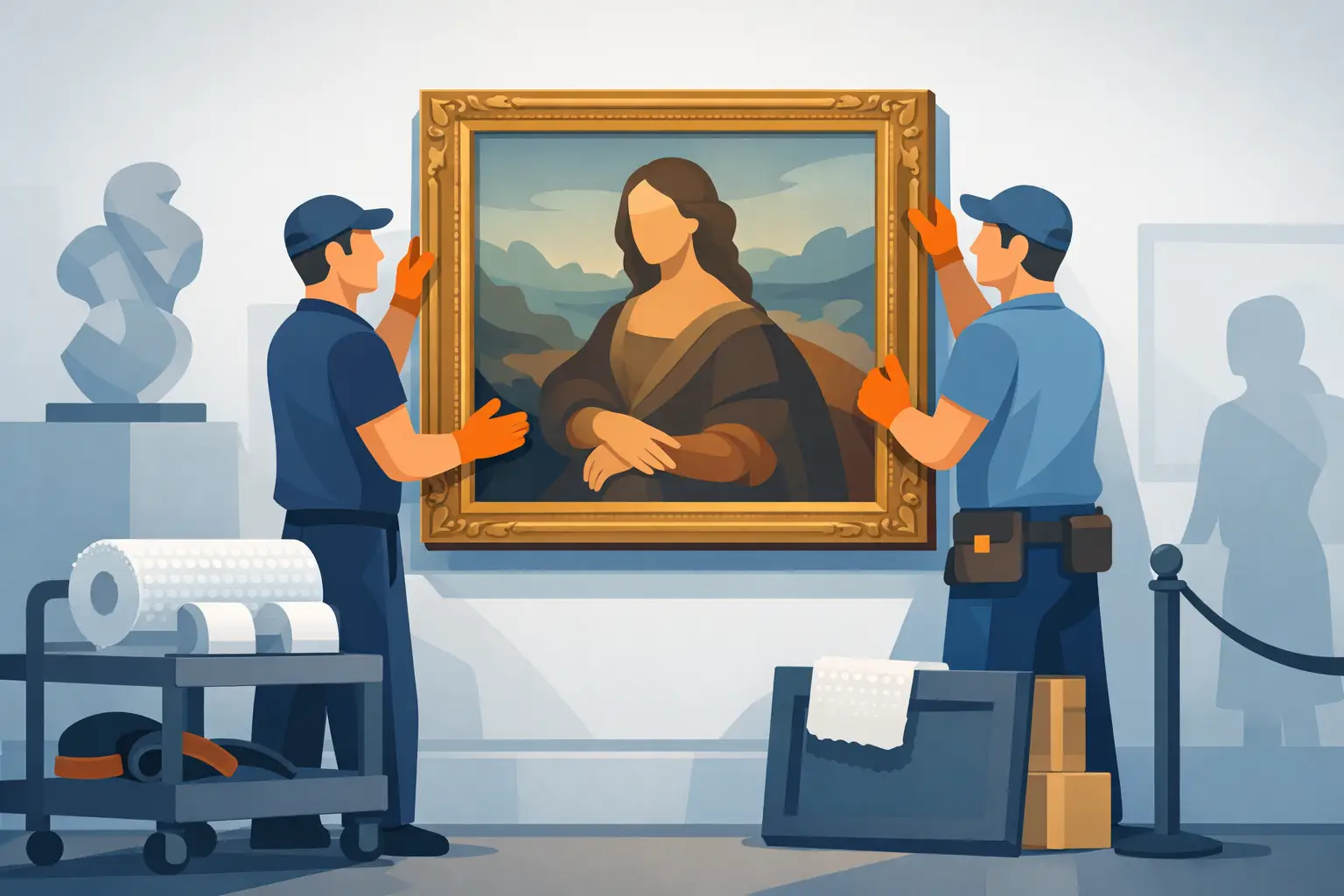
A painting can look perfectly stable on the wall and still become vulnerable the moment it needs to move. The risk is rarely dramatic at first. It shows up in small failures – pressure on a frame corner, vibration during transport, an installer grabbing the wrong point, a rushed unpacking in the wrong environment. That is why museum art handling is not simply careful labor. It is a controlled process designed to protect condition, preserve value, and maintain presentation from the first assessment to the final placement.
For collectors, galleries, designers, and institutions, the standard matters because the object is rarely replaceable. A work may carry financial value, historical significance, or personal meaning that cannot be recovered after preventable damage. Professional handling reduces that risk by replacing assumptions with method.
What museum art handling actually means
Museum art handling refers to the disciplined methods used to move, pack, transport, install, and document artwork without compromising its condition. The emphasis is not only on caution. It is on procedure. Each object is evaluated for its materials, weight, age, fragility, surface sensitivity, and mounting requirements before anyone touches it.
That distinction matters. A large framed canvas, a polished sculpture, and a mixed-media piece with unstable elements may all require completely different handling plans. The same is true for works that appear similar but have different structural issues. One frame may be decorative but sound. Another may look solid while carrying hidden weakness at the joints.
Museum-level care starts with understanding the object, then building the movement around that understanding. It is not a moving service with extra blankets. It is a risk-managed operation.
Why museum art handling standards matter
Most damage happens during transition points. Deinstallation, packing, loading, unloading, staging, and installation all create moments when the artwork is exposed to human error and environmental change. A work that has hung undisturbed for years can be damaged in a matter of seconds if lifted incorrectly or packed with the wrong materials.
High standards matter because art is affected by more than impact. Abrasion, compression, shifting humidity, poor support, and contaminated packing surfaces can all create problems. Some issues are immediately visible. Others appear later, after transport stress reveals a weakness in the surface, stretcher, glazing, or joinery.
For clients managing private collections or active exhibition schedules, there is also an operational side to consider. Proper handling supports condition reporting, chain of custody, scheduling, and coordination with installers, registrars, designers, or receiving teams. Good handling protects both the object and the project.
The process behind professional museum art handling
The strongest handling programs begin before the crate is built and before the truck is scheduled. They start with a detailed review of the artwork itself. Dimensions, weight, media, orientation, vulnerabilities, access points, and destination conditions all influence the plan.
A condition check often comes first. This establishes the artwork’s current state and identifies areas that require special attention, such as lifting paint, weak hanging hardware, unstable bases, or previous repairs. Without that baseline, teams are making decisions without critical information.
From there, handling methods are matched to the object. Some works require soft wrap and rigid support. Others need travel frames, shadowboxing, custom crating, or vibration-conscious packing systems. Oversized works may require route planning through elevators, stairwells, and entryways before movement begins. The plan has to fit the actual site conditions, not an ideal version of them.
Transport is another place where experience matters. Securing art inside a vehicle is not just about preventing sliding. It is about orientation, spacing, suspension effects, temperature considerations, and reducing unnecessary movement during every stage of the trip. The goal is controlled transit, not simply successful delivery.
Installation completes the chain. Placement, mounting method, wall composition, hardware selection, and sightline alignment all influence the outcome. A professionally handled work should arrive in the same condition it left and be installed in a way that is secure, level, and appropriate for both the object and the space.
Museum art handling is never one-size-fits-all
This is where many projects succeed or fail. Clients sometimes assume white glove service means the same protocol can be applied across every category of artwork. In practice, handling always depends on the piece.
A contemporary acrylic box may need strict surface protection because it scratches easily. A heavy bronze may be structurally resilient but dangerous to maneuver without the right rigging approach. Works on paper are highly sensitive to flexing, pressure, and environmental exposure. Sculptures with protruding elements can be stable in a gallery and extremely vulnerable in transit.
The setting matters too. Installing in a private residence calls for one set of logistics. Coordinating a multi-piece delivery into a hospitality property, high-rise tower, or active gallery space introduces another level of access management and sequencing. Museum-level care means accounting for all of it – object, route, environment, and final presentation.
What clients should expect from a qualified art handling team
A qualified team should be able to explain not just what will happen, but why. That includes how the piece will be lifted, what materials will touch the surface, whether custom packing is needed, how the route will be managed, and what installation hardware is appropriate.
Clients should also expect discipline. That means clean handling practices, coordinated crew communication, attention to condition, and a measured pace. Rushed work is rarely careful work. The best teams move efficiently, but they do not improvise when the object requires a different approach.
Documentation is another sign of professionalism. For higher-value projects, clear records around condition, packing, transport, and delivery help protect everyone involved. This is especially important when works are moving between multiple stakeholders, locations, or phases of a project.
Discretion should not be overlooked. Serious collectors, designers, and institutions often need operational privacy as much as technical skill. Professional art handling includes respect for the client, the property, and the sensitivity of the collection.
Common mistakes that put artwork at risk
The most common mistake is treating fine art like premium furniture. Protective blankets and careful carrying may be enough for household goods, but they are not a substitute for object-specific planning. Art fails in different ways, and each medium has its own vulnerabilities.
Another frequent problem is poor packing selection. Overpacking can be as harmful as underpacking if pressure is placed on fragile surfaces or decorative elements. The right solution depends on the piece, the distance traveled, and the number of handling points along the route.
Improper installation is equally risky. Hardware that is strong enough for the weight may still be wrong for the artwork or the wall substrate. In other cases, the work is secure but visually misaligned, which affects presentation even if no physical damage occurs.
There is also the issue of incomplete coordination. If a team arrives without confirmed dimensions, access details, or placement instructions, the project becomes reactive. That is when avoidable mistakes tend to happen.
When museum-level handling is worth it
For some pieces, museum-level handling is clearly non-negotiable. Works with significant value, fragile media, historic importance, or complex installation requirements belong in that category immediately. So do multi-stop projects, exhibition rotations, and moves involving custom crating or long-distance transport.
But there are also quieter cases where the same standard makes sense. A sentimental family portrait, a large mirror-polished sculpture, or a designer-specified installation in a finished interior may not be museum property, yet the tolerance for damage is still extremely low. In those situations, the cost of expert handling is often modest compared with the cost of repair, replacement, or visual compromise.
In Miami and across South Florida, where collections often move between residences, galleries, fairs, and seasonal properties, the need for technical consistency becomes even more relevant. ARTSOLVE approaches these projects with the same principle that guides museum care: the plan should fit the object, not the other way around.
The best art handling is often invisible to the client. The work arrives safely, the installation looks exact, the space remains protected, and the process feels calm from start to finish. That is the point. When valuable artwork is involved, confidence comes from precision that never needs to call attention to itself.
Need Help Installing Your Artwork?
From private residences to commercial and hospitality spaces, ART SOLVE provides professional art installation throughout Miami and South Florida, with the precision, care and experience valuable artwork demands.


