
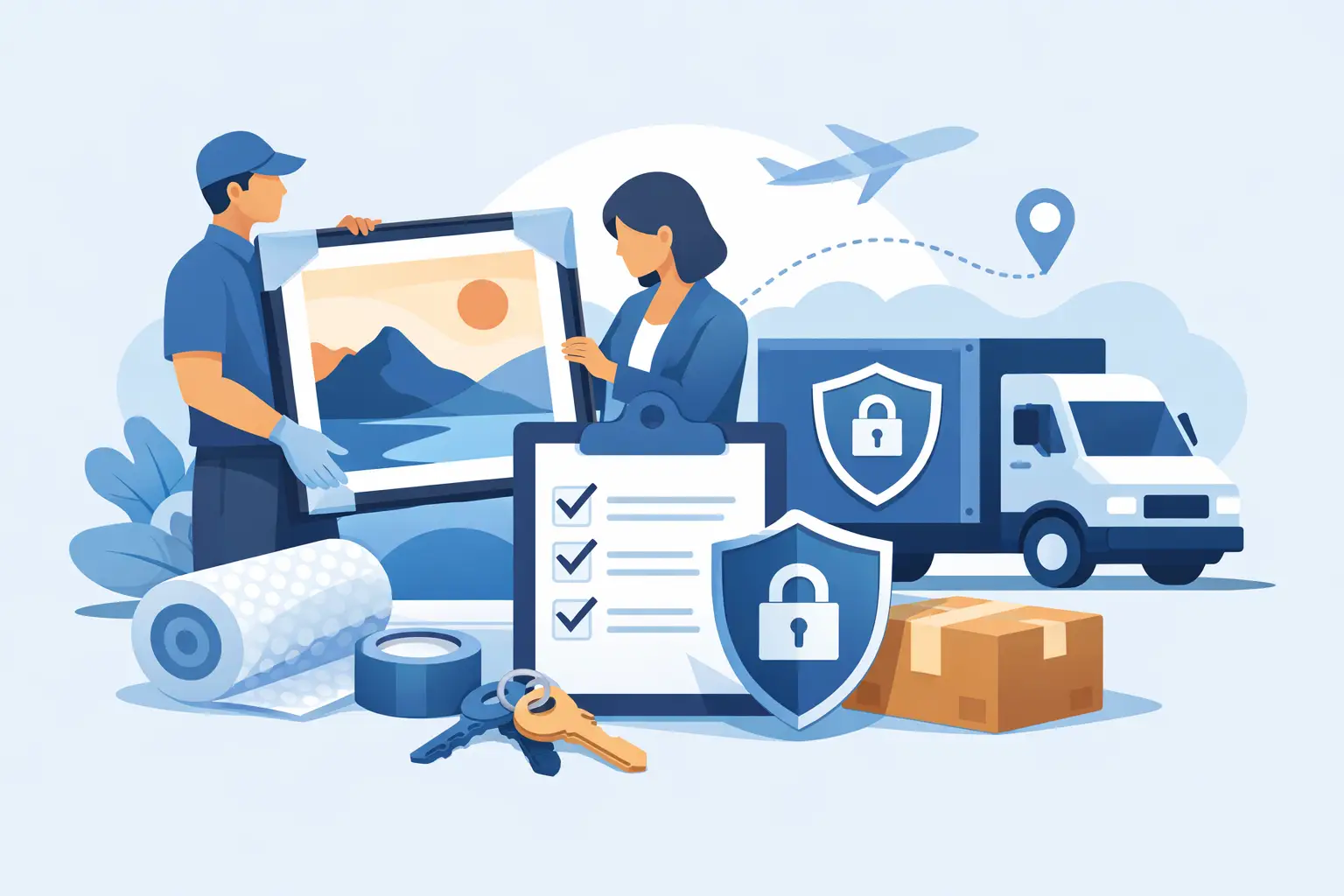
A delivery can go wrong long before the truck door closes. Damage often starts with rushed condition notes, generic packing, unclear site access, or a handoff to people who do not understand the object in front of them. A secure artwork delivery checklist helps prevent those avoidable failures by treating transport as a controlled chain of decisions, not a simple pickup and drop-off.
For collectors, galleries, designers, and institutions, that distinction matters. Fine art is rarely interchangeable. A framed work with glazing, a large sculpture with vulnerable protrusions, and a textile installation all require different handling logic. The safest delivery process begins with assessment, continues through packing and transport, and ends only when the piece is placed, inspected, and documented in its new location.
What a secure artwork delivery checklist should actually cover
A useful checklist is not just a packing list. It should account for the artwork itself, the route it will travel, the people handling it, and the environment at both ends of the move. If one of those four areas is overlooked, risk increases quickly.
The first area is object assessment. Before any packing decision is made, the artwork should be reviewed for medium, dimensions, weight, structural vulnerabilities, and existing condition issues. A stable framed print may travel safely with one protection method, while a mixed-media work with raised surfaces may need spacing, custom supports, or a full crate. Without that assessment, even careful handlers can use the wrong materials.
The second area is documentation. Condition reporting should happen before transit, not after a concern appears. Measurements, photographs, orientation markings, and installation notes all reduce ambiguity. This is especially important when an artwork is moving between a studio, residence, gallery, storage facility, or project site where multiple stakeholders may be involved.
The third area is logistics planning. Secure delivery depends on details that are easy to underestimate, such as stair access, elevator size, parking restrictions, loading dock procedures, receiving hours, and wall readiness. A flawless crate does not solve a bad entry path.
The fourth area is final placement. Delivery is not complete when the object arrives. The receiving environment should be prepared, the unpacking should be controlled, and the artwork should be checked again before sign-off. If installation is part of the scope, that stage should follow a precise placement plan rather than improvised decision-making in the room.
Pre-delivery assessment and condition control
Any secure artwork delivery checklist should begin with a close review of the piece itself. That means documenting dimensions accurately, confirming weight, noting medium-specific sensitivities, and identifying areas that cannot bear pressure. Corners, stretcher bars, hanging hardware, glazed surfaces, unstable frames, and fragile decorative elements should all be reviewed in advance.
Condition documentation is equally important. High-resolution photographs taken from multiple angles create a reference point before the artwork moves. Existing scratches, abrasions, craquelure, frame wear, or prior repairs should be recorded clearly. This protects the owner, the consignee, and the handling team by removing guesswork later.
There is also a practical side to condition planning. If a work already has structural concerns, the safest choice may not be immediate transport. In some cases, stabilization or adjusted handling methods are necessary first. That is one of the most common trade-offs in art logistics: moving quickly may satisfy a timeline, but it can increase the risk to the object if the piece is not transit-ready.
Packing decisions should match the artwork, not the schedule
Packing is where many deliveries become vulnerable because people confuse coverage with protection. Wrapping an artwork in layers of generic material does not automatically make it safe. Proper packing should control movement, shield vulnerable surfaces, and account for the artwork’s form, finish, and destination.
Soft packing may be appropriate for some local transfers when the piece is stable, the route is short, and the handling chain is tightly managed. For higher-value, fragile, oversized, or one-of-a-kind works, custom crating is often the more secure choice. The difference is not only about impact protection. A well-built crate also creates predictability during loading, stacking restrictions, and final handling.
Materials matter. Direct contact surfaces should be clean, non-abrasive, and suitable for the medium. Interior supports should prevent shifting without putting stress on the artwork. Exterior labeling should include orientation, handling instructions, and any unpacking precautions. If humidity, vibration, or glazing breakage are concerns, those factors should shape the packing plan from the start.
Rushed packing usually leaves evidence: loose interiors, pressure points, exposed corners, or missing orientation marks. Those are not cosmetic mistakes. They are warning signs that the delivery plan was not built around the object.
Chain of custody, scheduling, and transport security
A strong secure artwork delivery checklist should identify who is responsible at every stage. That includes release at origin, loading supervision, transport oversight, receiving contact, unpacking, and final approval. When roles are vague, small miscommunications turn into larger risks.
Scheduling should be specific. Pickup windows, transit duration, contact names, and site readiness should all be confirmed before the move begins. If the receiver is unavailable, the elevator is out of service, or a loading dock reservation was never secured, the artwork may end up waiting in an uncontrolled environment. For fine art, waiting is not a neutral event.
Vehicle standards also matter. Clean interiors, proper tie-down methods, and secure placement are basic expectations, but they are not the full story. The transport approach should match the artwork type and route conditions. A short private delivery with direct supervision is very different from a multi-stop run where works are repeatedly shifted. Fewer touchpoints generally mean lower risk.
Discretion is another practical part of security. High-value artwork should not be treated like standard freight. Controlled communication, limited unnecessary exposure, and professional handling protocols help protect both the piece and the client’s privacy.
Site readiness at pickup and delivery
Two sites can create as much risk as the road between them. Before pickup, the path from wall, pedestal, or storage rack to vehicle should be reviewed for clearance, floor protection needs, tight turns, and obstacles. Before delivery, the same review should happen at the destination.
A secure artwork delivery checklist should confirm whether walls are finished, blocking is in place, pedestals are level, and the final location is ready to receive the piece. If installation hardware, lift equipment, or additional handlers are needed, that should be decided in advance. Last-minute improvisation is one of the most common causes of handling damage.
Environmental conditions may also be relevant. Not every delivery requires strict climate management, but some do. Works on paper, sensitive surfaces, and certain mixed-media pieces can react poorly to excessive heat, humidity, or abrupt environmental swings. In South Florida, weather exposure during loading and unloading deserves real attention, especially during rain-prone periods.
The receiving process is part of the protection plan
Arrival is not the finish line. Unpacking should happen in a clean, controlled area with enough space to move safely. Tools should be selected to avoid accidental contact with frames, canvases, or crate interiors. Packaging should be removed in sequence, not torn away quickly because everyone is eager to see the piece.
Once unpacked, the artwork should be inspected against the pre-delivery condition record. That comparison should happen before disposal of materials and before the handlers leave the site. If there is any concern, documentation should be immediate and clear. Delayed reporting makes resolution harder and often less accurate.
When installation follows delivery, placement should be deliberate. Sightlines, mounting security, hardware suitability, and environmental exposure all affect the artwork after transport. A beautiful delivery loses value if the piece is then installed on an unstable wall or in direct risk from traffic, sunlight, or vibration.
A working secure artwork delivery checklist
For clients managing a delivery, the most practical checklist is simple and disciplined. Confirm condition photos and measurements, identify vulnerabilities, choose packing based on the medium and value, verify site access at both ends, assign handling responsibility, confirm the schedule, prepare the receiving area, inspect on arrival, and document final placement.
That may sound straightforward, but execution is where standards separate professional art logistics from general moving practices. White glove handling is not only about being careful. It is about making the correct decision before each point of contact. That is why collectors, galleries, and designers often rely on specialists such as ARTSOLVE when the object, presentation, and risk profile call for museum-level care.
The most reliable deliveries usually look uneventful from the outside. That is the goal. When the planning is precise, the packing is appropriate, and the handoff is controlled, the artwork arrives as it should – quietly, securely, and ready to be seen in the right condition.
Need Art Courier & Delivery in Miami?
ARTSOLVE provides art transportation and courier delivery across Miami and South Florida. Keep collections and exhibitions together with continuous chain of custody, specialized white-glove handling and installation upon delivery when included in your project.


