
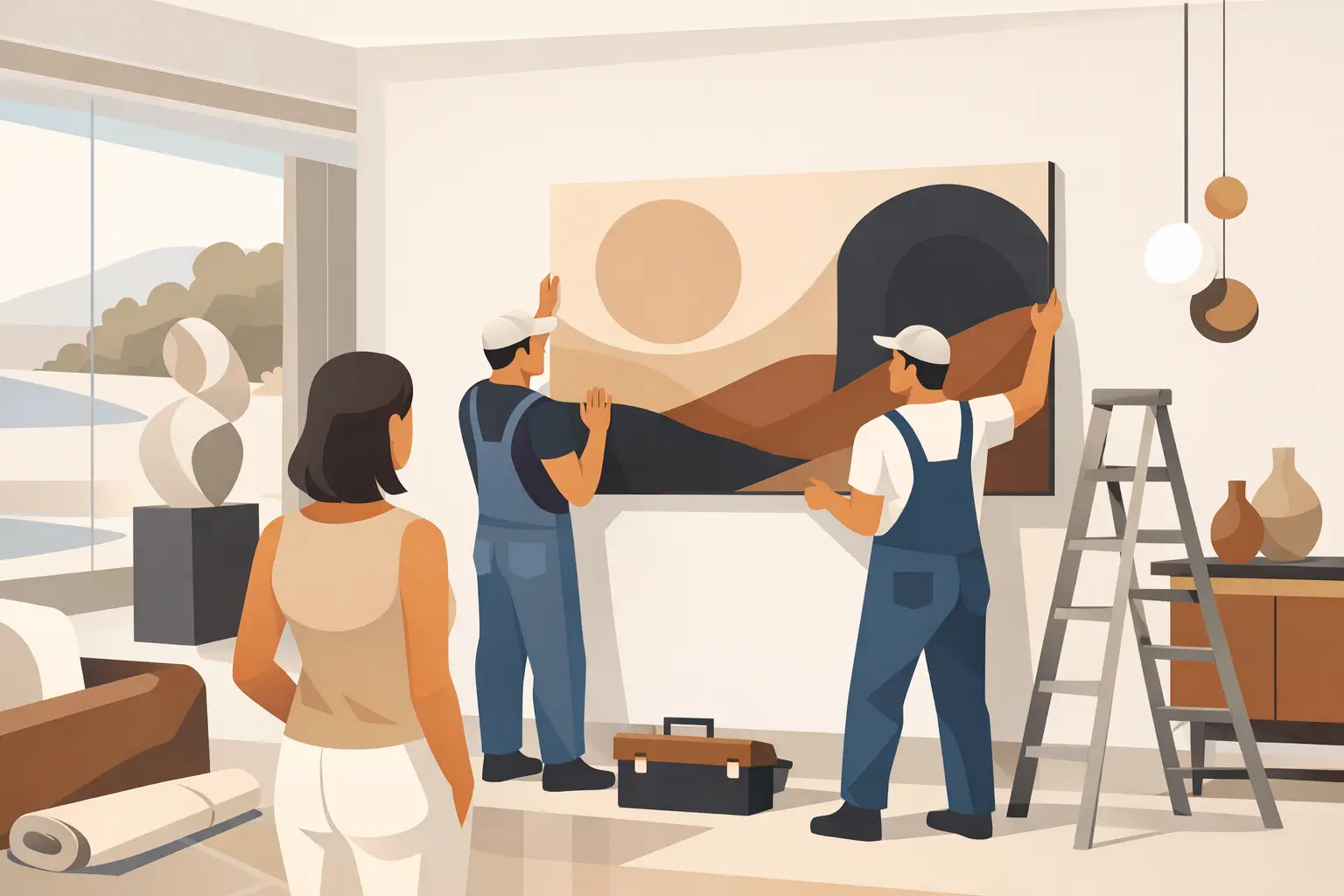
A large painting arriving at a waterfront residence may look like the final step in a collecting journey. In reality, the most vulnerable moment often comes after delivery, when the work is moved through finished interiors, positioned under exact lighting, and secured to remain stable for years. Luxury home art installation is not simply about hanging art on a wall. It is a technical, aesthetic, and risk-sensitive process that protects both the artwork and the home.
For collectors, designers, and property managers, the difference between a basic installer and a fine art team shows up quickly. Weight distribution, wall composition, hardware selection, sightlines, environmental conditions, and handling protocols all affect the outcome. When the work is valuable, fragile, oversized, or irreplaceable, installation quality is part of asset protection.
What luxury home art installation really involves
In a high-value residential setting, installation begins long before a single tool is unpacked. Each artwork needs to be assessed for dimensions, weight, medium, framing details, mounting needs, and any vulnerabilities in the surface or structure. A framed photograph requires a different approach than a mixed-media panel, a sculpture with a delicate patina, or a multi-piece installation that must read as one composition.
The home matters just as much as the artwork. Stone, plaster, millwork, concrete, glass, and specialty wall finishes all demand different anchoring strategies. Ceiling heights, stair access, elevator dimensions, and floor protection requirements affect how a piece can be moved and where equipment can be used safely. In luxury residences, the installation team is working inside a finished environment where a scratched floor, chipped corner, or poor patch job is unacceptable.
That is why serious art installation is usually managed as a coordinated operation rather than a quick site visit. The goal is to arrive with the right hardware, the right handling plan, and the right crew configuration from the start.
Why residential art installation fails
Most installation problems are not dramatic. They are small technical mistakes that create visible flaws or long-term risk. A piece may be centered on the wall but wrong for the room’s sightline. A mount may hold initially but place uneven stress on the frame. A heavy sculpture may sit on a surface not designed for point-load weight. A team may use general-purpose anchors where a more specialized solution is required.
The issue is often a lack of art-specific judgment. General movers and handyman-style installers may be capable with ordinary décor, but fine art introduces different stakes. Works can have unstable surfaces, float frames, hidden weak points, conservation concerns, or strict installation requirements from the artist, gallery, or fabricator. The right result depends on understanding both presentation and preservation.
In luxury homes, there is also the matter of discretion and coordination. Installers may need to work around interior designers, household staff, building protocols, and tight scheduling windows. An experienced fine art team understands how to execute efficiently without turning the home into an active job site longer than necessary.
Planning a luxury home art installation
A proper installation plan usually starts with a site review and artwork review. That may be done through detailed dimensions, condition records, photos, or an in-person assessment depending on the complexity of the project. At this stage, the key questions are straightforward. How will the artwork enter the property? What are the wall conditions? What mounting method is appropriate? Does the piece need security hardware, anti-tip protection, or seismic-style restraint? Is there a lighting or placement issue that should be resolved before installation day?
Scale is one of the most common variables. Artwork that looked balanced in a gallery can feel compressed in a residence with high ceilings and expansive walls. The opposite can also happen, especially when collectors try to fit substantial works into intimate rooms. Good installers do not make curatorial decisions for the client, but they do flag practical and visual concerns before the work is committed to a placement.
For multi-work groupings, precision becomes even more critical. Spacing, alignment, visual rhythm, and reference height all need to be established before drilling begins. Minor inconsistencies become obvious in a clean residential setting, especially with salon walls, paired works, stair runs, or corridor presentations where perspective exaggerates every error.
Hardware, mounting, and wall conditions
The visible result of an installation is only as good as what sits behind it. Hardware must match the piece, the substrate, and the expected load over time. That may mean security cleats, French cleats, specialty anchors, direct-mount systems, pedestal stabilization, or custom-fabricated solutions. There is no single best method for every artwork.
Framed works often require more than two hooks and a level. Heavy frames may need load distribution across several points. Acrylic glazing changes weight and handling behavior. Deep shadowbox frames can shift differently than flat framed works. Sculptural pieces and wall reliefs may require hidden armatures or structural support that must be planned in advance.
The wall itself can be the deciding factor. Drywall over metal stud framing behaves differently than solid masonry or reinforced surfaces. Decorative wall treatments may be vulnerable to cracking or compression. In some luxury homes, the installation challenge is not whether a work can hang in a certain location, but whether it can be mounted there without compromising the finish or requiring visible hardware.
Protecting the artwork during installation
Collectors often focus on shipping risk, but installation handling can be equally sensitive. Uncrating, staging, carrying, and temporary placement all create exposure. Gloves, padded surfaces, corner protection, clean staging zones, and controlled movement paths are basic requirements when handling fine art in a residence.
Condition awareness is also essential. If a work arrives with existing wear, that should be documented before installation proceeds. If a frame corner is under tension or a canvas has a vulnerable area, the team needs to adjust its handling plan. This is one reason white glove service matters. A qualified crew is not just moving efficiently. It is reading the object in real time and working accordingly.
In South Florida homes, climate considerations may also affect planning. Large windows, humidity fluctuations, and direct sun exposure can influence placement decisions. Not every beautiful wall is a suitable location for a sensitive work on paper, textile, or certain painted surfaces. Installation should support the long-term life of the artwork, not only the immediate visual effect.
Working with designers, collectors, and household teams
Luxury home art installation often sits at the intersection of design intent and conservation-minded execution. An interior designer may have a strong vision for composition and flow. A collector may prioritize provenance, security, and preservation. A property manager may need building compliance and minimal disruption. The installation team has to translate all of that into a clean, precise result.
This is where communication becomes part of the service. Clear approvals on placement height, orientation, grouping layouts, and special hardware prevent avoidable revisions. So does confirming access restrictions, parking, service elevator rules, and protection requirements before arrival. The best projects feel calm because the complexity was handled upstream.
For larger residential projects, sequencing matters. Art should not be installed too early in an active construction or furnishing phase. Dust, ladder traffic, tradespeople, and unfinished climate control can create unnecessary exposure. Waiting a few extra days is sometimes the safer decision, even if the artwork is ready.
When custom handling is worth it
Not every residence needs an elaborate installation plan. Some projects are straightforward. But custom handling becomes especially important when the artwork is oversized, unusually fragile, exceptionally valuable, or being installed in a difficult architectural setting. The same is true when a project includes multiple floors, rotating selections, paired transport and installation, or works arriving from storage, a gallery, or an art fair.
In those cases, a tailored process protects more than the object. It protects the schedule, the residence, and the client relationship behind the project. That is why experienced collectors and design professionals tend to rely on specialists. They are not paying for extra ceremony. They are reducing variables.
In Miami’s residential market, where contemporary architecture, major collections, and design-led interiors often meet in one property, that level of control matters. ARTSOLVE approaches installation with the same museum-level care used in handling, transport, and project coordination, because the final placement is not a minor detail. It is the moment where protection and presentation have to work together.
A well-installed piece should feel effortless once it is in place. That appearance of ease usually comes from careful planning, disciplined handling, and respect for every surface involved – the artwork, the wall, and the home itself.
Need Help Installing Your Artwork?
From private residences to commercial and hospitality spaces, ART SOLVE provides professional art installation throughout Miami and South Florida, with the precision, care and experience valuable artwork demands.


