
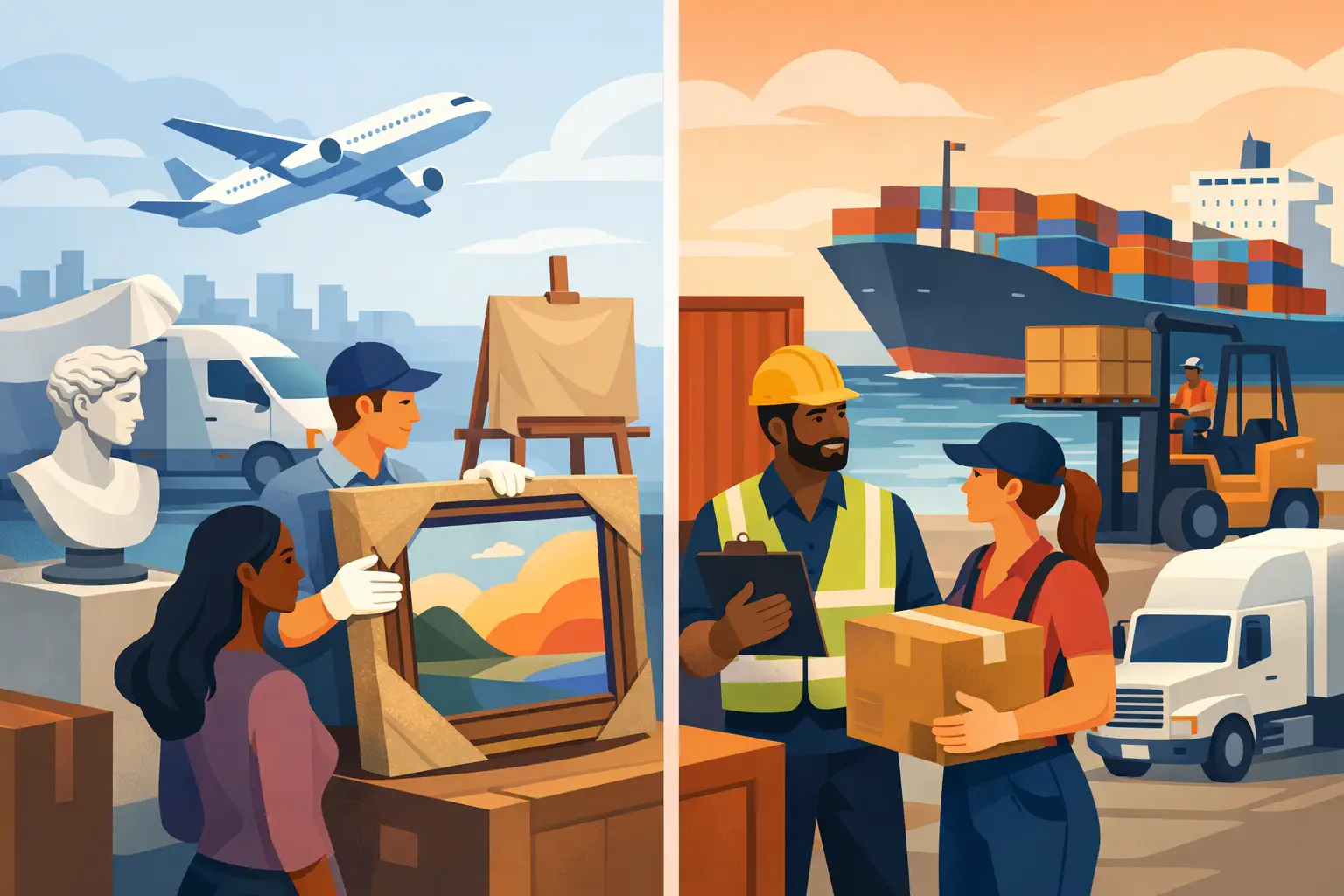
A sculpture can arrive at the correct address, on the correct date, and still fail the assignment if its surface is abraded, its components shift, or its condition is no longer documented. That is the practical distinction behind fine art shipping vs freight. Both move objects from one location to another, but they are built around very different assumptions about value, handling, responsibility, and final presentation.
For collectors, galleries, designers, and institutions, the decision is rarely just about transit cost. It is about choosing a process that matches the artwork’s physical needs and the standards expected at delivery.
Fine Art Shipping vs Freight: The Core Difference
Freight is a broad transportation category designed to move goods efficiently. It may involve palletized shipments, shared trucks, distribution terminals, loading docks, and transfers between carriers. This model can be appropriate for durable, well-packaged commercial items that can tolerate standardized loading and transport conditions.
Fine art shipping is a specialized handling process for artwork that requires controlled packing, trained personnel, tailored transport planning, and careful delivery. The objective is not simply to deliver a package. It is to preserve the work’s physical condition, provenance documentation, security, and presentation from collection through final placement.
The difference matters because artwork is often irregular, fragile, and irreplaceable. A canvas may be sensitive to vibration and puncture. A framed work may have vulnerable glazing or corner ornamentation. A large-scale installation may require multiple components to remain in sequence. Even a seemingly sturdy sculpture can have a delicate patina, concealed joins, or a weight distribution that makes ordinary loading unsafe.
What Standard Freight Is Designed to Do
Freight systems are optimized around capacity, routing, and predictable unit loads. A carrier may combine shipments from many clients, use mechanical equipment for loading, and move goods through several facilities before final delivery. Each handoff increases efficiency, but it can also introduce variables that are not ideal for sensitive art.
That does not mean freight is inherently careless. Many freight carriers operate professionally within the scope of their service. The issue is fit. Standard freight procedures are generally not designed to assess an artwork’s condition, fabricate a custom crate, protect a fragile surface during handling, or coordinate a white glove installation at the destination.
A freight quote may also exclude services that are essential to an art project. Liftgate needs, inside delivery, appointment coordination, uncrating, debris removal, placement, and condition reporting can be separate or unavailable. For a collector receiving a work at a private residence or a gallery preparing for an opening, those details are not peripheral. They are part of the job.
What Fine Art Shipping Adds
Fine art shipping begins before a vehicle is scheduled. The artwork is assessed for dimensions, weight, materials, condition, vulnerability, access requirements, and destination needs. That assessment informs a handling plan rather than forcing the object into a standard shipping format.
Packing is central to that plan. Depending on the work, protection may include museum-quality soft wrapping, corner protection, archival materials, travel frames, shock-absorbing interior supports, or a custom crate. The purpose is to prevent movement within the package while avoiding contact that could mark, compress, or react with the artwork’s surface.
The handling team also matters. Fine art professionals understand how to lift framed works without stressing miters, how to manage glazed objects, where not to place pressure on a canvas, and how to move sculptures with stable support. They work with clean practices, appropriate equipment, and a clear chain of custody.
At delivery, fine art shipping extends to the final environment. That can include careful uncrating, inspection, placement, and professional installation. For a work headed into a designed residence, hospitality setting, exhibition, or collection storage area, the final few feet often carry as much risk as the journey itself.
When Freight May Be the Right Choice
Freight can be a sensible option when the artwork is low-risk, securely crated to a professional standard, and traveling in a format that does not require specialized attention at either end. It may also suit certain large or durable pieces when the client has qualified personnel to receive, inspect, and manage the work upon arrival.
Budget can be another valid consideration. Shared freight is typically less expensive than a dedicated art transport solution because the cost is spread across a larger load and a standardized route. If a project has flexible timing and the work can safely tolerate the freight model, the savings may justify the trade-off.
Still, the crate must be evaluated honestly. A crate protects an object, but it does not eliminate every risk associated with terminal handling, loading patterns, weather exposure, vibration, or multiple transfers. The question is not whether the work is in a box. It is whether the full transport process is appropriate for that specific object.
When Specialized Fine Art Shipping Is Worth It
Specialized shipping is usually the stronger choice for high-value, one-of-a-kind, fragile, oversized, historically significant, or surface-sensitive artwork. It is also appropriate when condition documentation, discretion, direct communication, and precise delivery coordination are essential.
Consider a painting leaving a Miami collector’s home for a gallery presentation. The project may require scheduled pickup, protective packing in the residence, careful navigation through finished interiors, condition review, direct transport, timed delivery, and installation-ready placement. A standard freight model may move the crate, but it does not naturally manage that full sequence.
The same is true for a designer coordinating art into a completed project. Walls may be newly finished, access may be limited, and the artwork may need to be placed exactly once in its intended location. In these circumstances, a lower transportation price can become costly if it leads to damage, delays, rework, or an incomplete delivery experience.
Compare the Full Scope, Not Only the Quote
When comparing fine art shipping and freight, ask what happens at every transition: pickup, packing, loading, transit, delivery, uncrating, inspection, and placement. A quote that appears lower may cover only dock-to-dock transportation, while a specialized art quote may include project coordination and hands-on care throughout.
It is useful to clarify whether transport is dedicated or consolidated, how many handoffs are expected, who handles the work, and what type of equipment will be used. Confirm the packing method, the delivery environment, and whether condition reporting is part of the process. If an artwork requires a custom crate, ask how internal support will prevent movement and how the crate will be opened without putting the work at risk.
Insurance should be reviewed separately from handling quality. Coverage can provide financial recourse after a loss, but it cannot restore an original surface, an artist’s intended finish, or a work with personal and cultural significance. The best approach is prevention through informed planning and museum-level care.
A Better Question Than “Which Is Cheaper?”
The more useful question is: what level of control does this artwork need? A work with modest market value may still demand specialized handling because it is fragile, sentimental, or impossible to replace. Conversely, a heavily built and professionally crated work may be suitable for freight under the right conditions.
There is no single answer for every shipment. The right choice depends on the artwork, the route, the required timeline, the packing standard, and the receiving environment. ARTSOLVE approaches these decisions as handling plans, not generic moves, because the details that protect a collection are rarely generic.
Before arranging transport, document the artwork’s current condition and discuss its material risks with the people responsible for handling it. That early conversation gives every later step, from packing through final installation, a clearer standard of care.
Need Art Courier & Delivery in Miami?
ARTSOLVE provides art transportation and courier delivery across Miami and South Florida. Keep collections and exhibitions together with continuous chain of custody, specialized white-glove handling and installation upon delivery when included in your project.


