
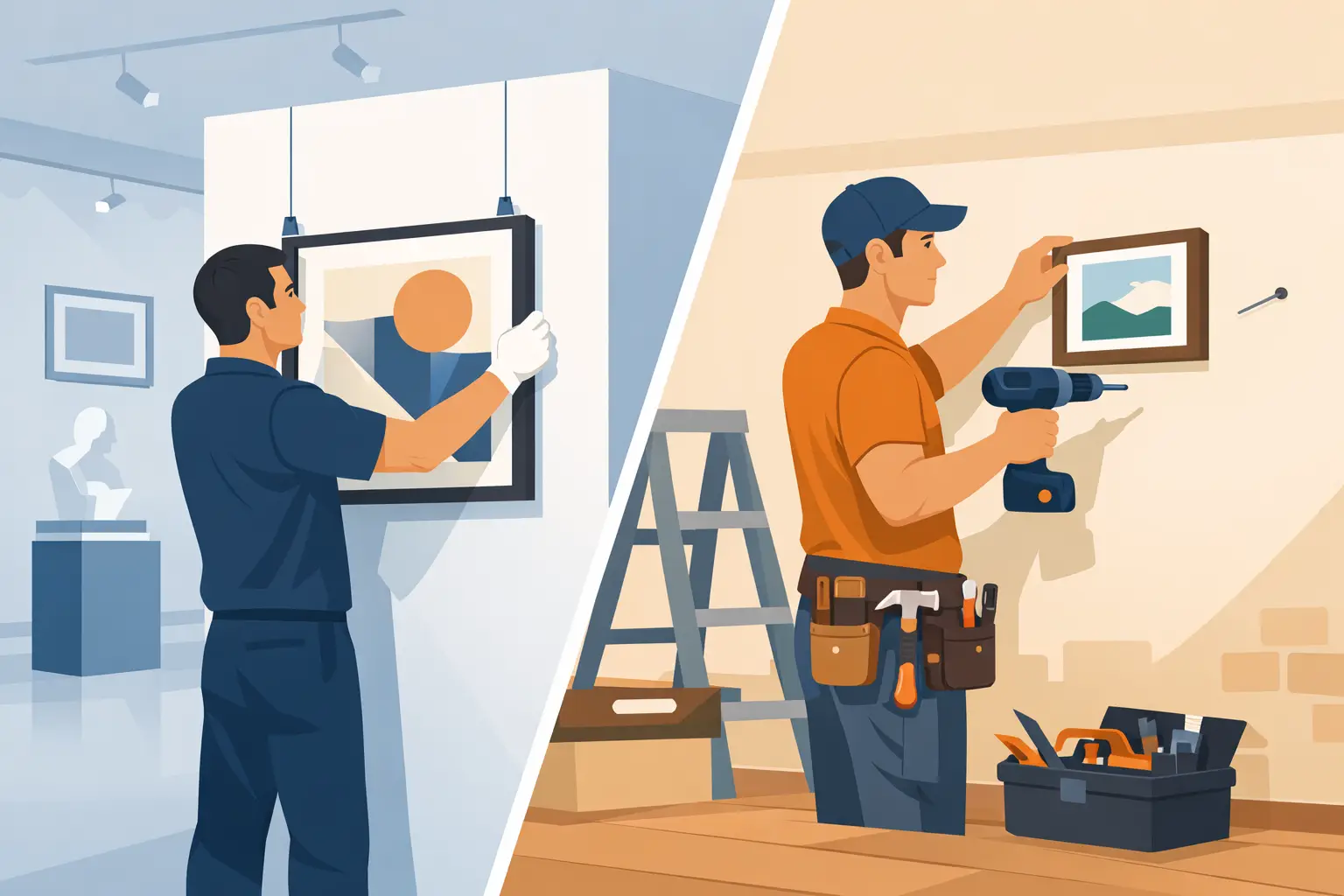
A framed work can look perfectly secure for the first ten minutes and still be installed incorrectly. The issue in a gallery installation vs handyman decision is not whether a piece can be hung on a wall. It is whether the artwork is assessed, handled, mounted, and presented with the level of care its value, fragility, and context require.
For decorative objects or standard household tasks, a handyman may be the practical choice. Fine art is different. The weight distribution of a large framed photograph, the surface sensitivity of a painting, the mounting needs of sculpture, and the wall conditions in a luxury residence or commercial space all change the risk profile. When the work is valuable, one of a kind, or tied to a broader design or exhibition plan, installation becomes a specialized discipline.
What changes in a gallery installation vs handyman project
The most useful distinction is this: a handyman is usually hired to complete a task, while a professional art installer is hired to protect an asset and control the outcome.
That difference affects every stage of the job. A specialized installer begins by reviewing the artwork itself, not just the wall. The team considers dimensions, weight, glazing, frame construction, hanging hardware, media sensitivity, and any vulnerabilities during unpacking or placement. They also assess sightlines, spacing, hardware compatibility, substrate conditions, and what can happen if the piece needs future removal, rotation, or transport.
A handyman may be capable, careful, and well intentioned. But most are not trained to approach artwork as a high-care object with aesthetic, financial, and conservation implications. Their expertise is broad by design. Gallery installation is narrow, technical, and detail driven.
Why hanging art is not the same as installing fine art
People often reduce installation to alignment. Straightness matters, but it is only one part of the standard.
Professional installation includes handling protocol before the artwork ever reaches the wall. That means clean staging, proper lifting, protective materials, awareness of frame pressure points, and careful management of corners, glazing, and finished surfaces. It also means choosing hardware based on load, wall composition, and long-term stability rather than convenience.
Presentation matters just as much. In a gallery, private collection, model residence, hospitality setting, or design-led commercial space, small visual errors are immediately visible. Uneven spacing between pieces, incorrect center lines, poor relation to furniture, or inconsistent heights can undermine the entire room. A specialist treats installation as both a technical and curatorial exercise.
That is especially relevant when multiple works are being installed together. A salon wall, a stair sequence, a lobby arrangement, or a collection spread across several rooms requires planning, measurement discipline, and visual judgment. The work needs to feel resolved, not merely attached.
Where a handyman may be enough
Not every project requires museum-level handling. If you are hanging a low-value decorative print, replacing standard fixtures, or mounting objects with no special fragility or long-term importance, a handyman can be an efficient option.
The key is being honest about the stakes. If damage would be upsetting but not consequential, the lower-cost route may make sense. If replacement is simple, documentation is unnecessary, and exact presentation is not critical, general installation support may be adequate.
This is where clients sometimes misjudge the decision. They compare labor rates without comparing risk exposure. A modest savings upfront can disappear quickly if a frame is stressed, a wall anchor fails, glazing cracks, or a piece is positioned poorly and has to be removed and reinstalled.
Where gallery installation is the right call
Specialized installation is the stronger choice when the artwork has financial value, emotional importance, fragility, scale, or reputational significance. That includes original paintings, large framed works, sculptures, mixed media pieces, editions with delicate finishes, and works being installed in public-facing or design-critical environments.
It also matters when the project has moving parts. A collector receiving several pieces from storage, a gallery preparing a show, a designer finishing a residence, or a hospitality group coordinating artwork across multiple spaces needs more than someone who can use a level and a drill. They need process control.
That process may include condition review, coordinated delivery sequencing, custom hardware selection, on-site protection, placement consultation, and final adjustments based on lighting, architecture, and viewing distance. Those details protect the work and improve the final result.
In South Florida, environmental and construction variables can add another layer. Concrete, masonry, high-rise access, humidity-sensitive materials, and carefully finished interiors all raise the importance of experienced handling and installation planning.
The hidden risks of choosing by price alone
The gallery installation vs handyman question often starts as a budget conversation. That is understandable, but price alone is rarely the best filter when the object being installed is difficult or impossible to replace.
The most common failures are not dramatic. They are subtle and preventable. Improper anchor selection can create long-term instability. Poor handling during unpacking can leave minor abrasions on a frame. Inadequate spacing can make a strong collection look unresolved. A piece hung without regard to glare, traffic flow, or wall composition may be technically secure and still installed badly.
There is also the issue of accountability. A specialist typically works with clearer procedures around handling, staging, placement, and execution. That level of structure matters for collectors, galleries, and designers who need consistency, discretion, and confidence that the team on site understands the assignment.
When installation is treated casually, clients often end up managing details themselves. They answer avoidable questions, supervise placement, correct inconsistencies, and worry through the process. The right installer reduces that burden rather than adding to it.
What professional art installation actually includes
A proper fine art installation service is broader than many clients expect. It usually begins with evaluation – what the piece is, how it is framed or fabricated, how fragile it is, and what the site conditions demand.
From there, the work may involve protective unpacking, hardware review, measurement mapping, placement planning, and the physical install itself. For larger projects, there may be coordination with designers, registrars, collection staff, property teams, or shipping schedules. The standard is not simply that the piece ends up on the wall. The standard is that the artwork is protected from arrival through final placement.
That white glove approach is why specialized firms are trusted by collectors, museums and galleries. The value is in reducing risk while preserving presentation quality.
How to decide without overcomplicating it
A simple test is to ask what would happen if the job goes wrong. If the answer is a minor inconvenience, a handyman may be sufficient. If the answer includes damage, loss of value, compromised presentation, insurance concerns, or client embarrassment, use a specialist.
It also helps to consider whether the artwork is part of a larger objective. If the piece supports a collection strategy, exhibition, interior design concept, sales presentation, or hospitality experience, the installation quality carries more weight. In those cases, precision is not an extra. It is part of the project.
For many clients, the right answer is not about prestige. It is about fit. Specialized art installation exists because artwork presents problems that ordinary wall-hanging does not. When those problems are present, expertise pays for itself in protection, efficiency, and peace of mind.
ARTSOLVE works in that specialized category, where handling standards, presentation, and coordination have to hold up under close scrutiny. That level of care is not necessary for every object. But when the piece matters, the difference is visible from the first touch to the final inch of placement.
The better question is not who can hang it. It is who can install it in a way that respects the artwork, the space, and the stakes.
Need Help Installing Your Artwork?
From private residences to commercial and hospitality spaces, ART SOLVE provides professional art installation throughout Miami and South Florida, with the precision, care and experience valuable artwork demands.


4 Comments