
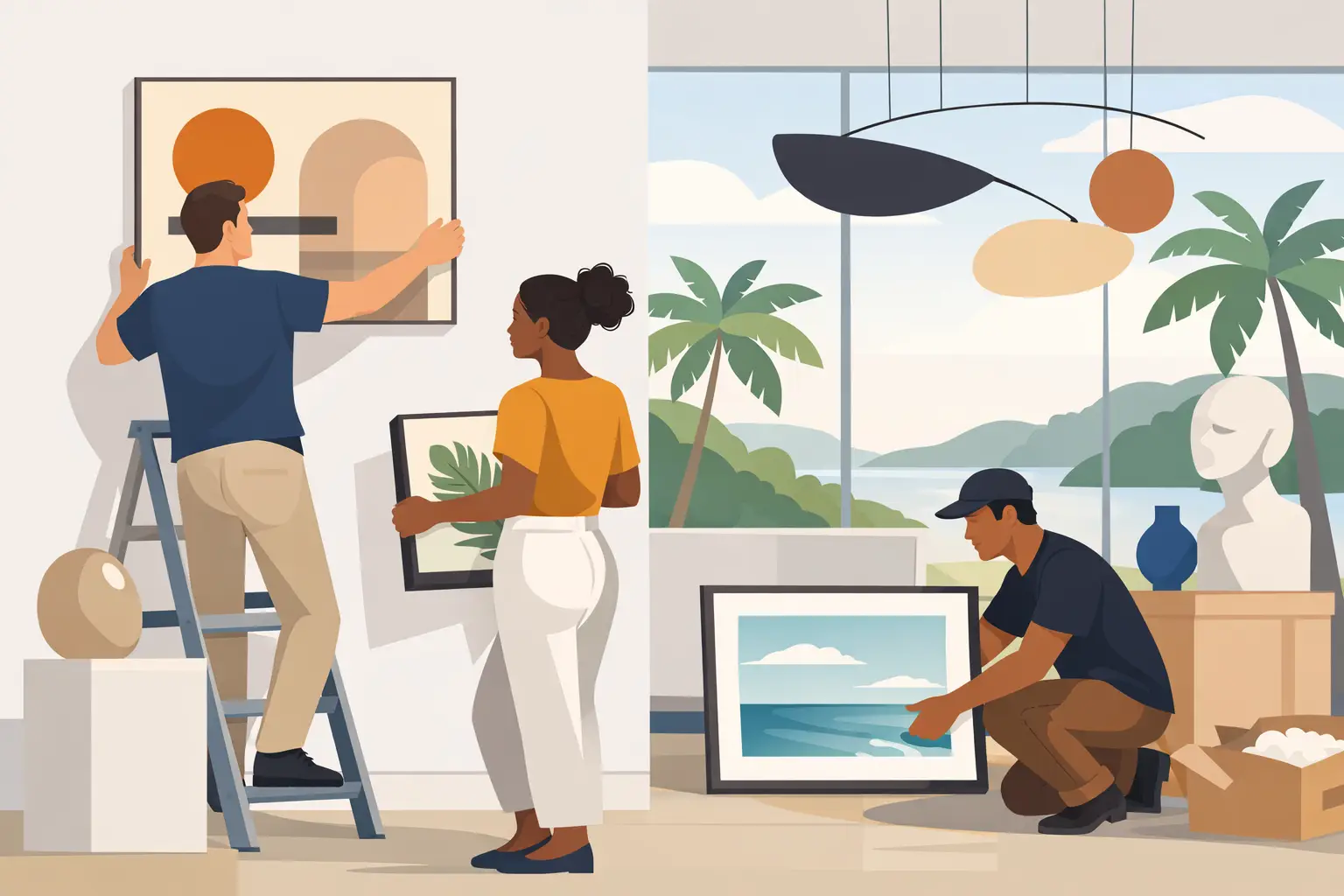
Art Installation in Coconut Grove for Homes and Private Collections
Art installation in Coconut Grove: services for homes & private collections require more than a careful hand and a level. A significant work may arrive with fragile edges, complex hanging requirements, an unconventional center of gravity, or a surface that cannot tolerate ordinary handling. Once it enters a residence, every decision – from the route through the property to the hardware behind the wall – affects both its safety and its presentation.
For collectors, designers, and homeowners, professional installation protects an investment while allowing the work to read as intended. In Coconut Grove, where residences range from historic homes to contemporary waterfront properties, installation plans should respond to the artwork, the architecture, and the realities of the site. That may mean assessing a plaster wall before drilling, coordinating elevator access, or planning a multi-piece installation around a room’s natural light and sightlines.
Why Fine Art Installation Is a Specialized Service
A framed print, a monumental canvas, a sculpture, and a mirrored work should not be approached with the same tools or assumptions. The right installation begins with an assessment of the object’s materials, dimensions, weight, framing, existing hardware, and condition. It also considers how the artwork will be viewed and what conditions it will encounter after placement.
Weight is only one part of the equation. A large work can exert force differently depending on its frame construction and hanging points. An irregular sculpture may need a concealed stabilization method. A work on paper may require added care around glazing, while a contemporary piece with electronic components may involve specific placement, access, and cable considerations. Museum-level care means identifying these variables before the work is in motion.
The wall itself matters just as much. Drywall, masonry, concrete, wood paneling, and decorative finishes require different anchoring strategies. An experienced art installation team determines the appropriate hardware and attachment points rather than relying on a standard picture hook. This protects the work, reduces risk to the property, and provides confidence that the installation will remain secure over time.
A Site-Specific Plan for Coconut Grove Residences
Coconut Grove homes often present details that deserve advance planning. Mature landscaping, narrow drives, multiple levels, staircases, custom millwork, and high-value interior finishes can all affect access. Waterfront and older properties may also have architectural conditions that are not immediately visible from a floor plan.
A site review gives the installation team an opportunity to identify the safest path from vehicle to final location. Measurements for doors, turns, elevators, stairwells, and wall areas prevent last-minute improvisation. If a large artwork cannot safely travel through a primary entry, the correct solution may involve a different access route or a coordinated plan for specialized handling. The objective is never simply to get the piece inside. It is to move it through the property without placing the artwork, finishes, or people at unnecessary risk.
Placement should also be intentional. A work can be technically secure yet visually compromised if it is hung too high, crowded by adjacent furnishings, or exposed to direct sun. Collectors and interior designers may arrive with a clear curatorial direction, while others benefit from professional input on height, alignment, spacing, and composition. The best approach depends on the collection, the room, and whether the work is meant to be a focal point or part of a broader visual arrangement.
Light, Humidity, and Everyday Living
South Florida’s climate is an ongoing consideration for private collections. Bright windows, high humidity, exterior doors that open frequently, and proximity to water can influence where an artwork belongs. Sensitive works may require a location away from direct sunlight, air-conditioning vents, or areas with frequent temperature changes.
This does not mean a home must feel like a gallery. It means the placement should respect the work’s material needs while supporting how the household actually lives. A valuable piece can be displayed beautifully in an active home when its location and mounting method are chosen with care.
What White Glove Installation Should Include
Fine art installation is most effective when it is part of a coordinated handling process. The work should be inspected before movement, protected during transport through the residence, and handled with clean, appropriate materials. If an artwork arrives from storage, a gallery, or another home, condition documentation and proper packing should carry through to final placement.
For a private collection project, the service commonly includes several connected stages:
- Pre-installation assessment of artwork dimensions, condition, hardware, access, and wall construction.
- Careful uncrating or unpacking, with packing materials retained or managed appropriately for future moves.
- Precise measuring, layout, and installation using hardware suited to the object and substrate.
- Final alignment, stabilization, surface check, and presentation review with the client or design team.
The level of coordination can expand when a collection is being installed across several rooms, residences, or floors. In these situations, sequencing matters. Work may need to be staged by room, placed after furniture delivery, or coordinated with designers, contractors, and building management. A project manager who understands art handling can keep those details organized without treating the artwork as ordinary household freight.
Installation for Growing and Evolving Collections
Private collections change. New acquisitions arrive, furniture moves, loans are arranged, and a room that once held a single painting may become a salon-style installation. Every adjustment creates another opportunity for accidental damage if works are moved casually or stored without protection.
A professional team can assist with rehangs, rotations, relocations within a residence, and installations following renovations. The value is not limited to labor. It comes from maintaining continuity of care: knowing how the work was packed, where it has been installed, what hardware is in use, and whether its condition changed during movement.
For collectors with multiple properties, documentation becomes especially useful. Basic records of placement, condition, dimensions, and handling requirements make future installation planning more efficient. They also support better communication among collection managers, designers, advisors, and family members responsible for the collection over time.
When Custom Crating or Additional Protection Is Needed
Not every artwork needs a custom crate for a local installation, but some do. Large-scale paintings, delicate sculpture, antique frames, high-value works, and pieces moving between locations may need custom-built protection before transport. The decision depends on the object’s fragility, value, geometry, travel distance, and route through the property.
Similarly, a straightforward framed work may be installed in a short visit, while a complex collection installation requires more preparation. The difference is not a matter of prestige. It is a matter of matching the level of protection and technical planning to the actual risk.
Selecting an Art Installation Partner
The right team should be able to explain its process clearly before work begins. Ask how artwork condition is assessed, how installers determine wall suitability, what protections are used during movement, and how the team addresses unusual materials or oversized pieces. The answers should be specific to your collection, not limited to generic moving practices.
Discretion is equally important in private homes. Professional installers work respectfully around occupied residences, confidential collections, and carefully finished interiors. They arrive prepared, coordinate efficiently, and leave the space orderly once the work is complete.
ARTSOLVE brings this level of planning to installations throughout Miami and South Florida, with white glove handling shaped around each artwork and site. For a single important acquisition or a residence-wide installation, the standard should be the same: thoughtful preparation, precise execution, and respect for what the collection represents.
A work of art earns its place in a home through more than where it hangs. When installation is handled with care, the viewer sees the artwork – not the logistics that made its presentation possible.
Need Help Installing Your Artwork?
From private residences to commercial and hospitality spaces, ART SOLVE provides professional art installation throughout Miami and South Florida, with the precision, care and experience valuable artwork demands.


