
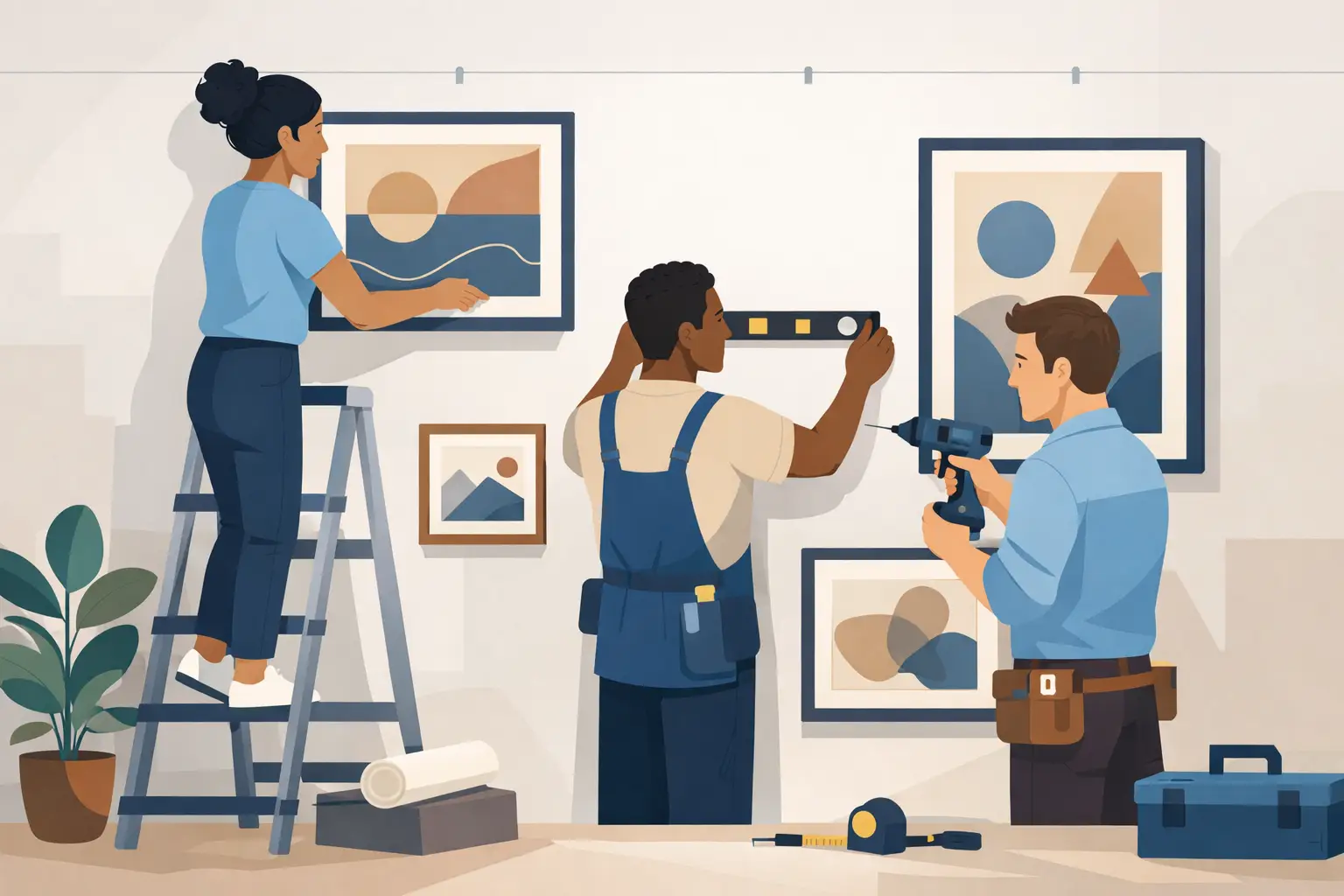
A painting can arrive in pristine condition and still be placed at risk in its final few feet. A guide to professional artwork installation begins with that reality: installation is not simply hanging art on a wall. It is the controlled final stage of a handling plan, where the artwork, its hardware, the wall structure, the environment, and the intended viewing experience must all work together.
For collectors, galleries, designers, and hospitality teams, the stakes are higher than a crooked frame. An improperly selected anchor can fail over time. Pressure on a gilded frame can cause damage at a vulnerable corner. An unverified placement can disrupt a carefully considered collection plan. Professional installation protects both the physical asset and the way it is experienced.
Begin With the Artwork, Not the Wall
Every installation decision should begin with an assessment of the object. The installer needs to understand the artwork’s dimensions, weight, center of gravity, frame condition, hanging hardware, glazing, and any fragile or unusual components. A large framed canvas, a delicate work on paper, a mirrored sculpture, and a multi-panel installation may all occupy the same room, but they require very different approaches.
Condition documentation is an essential part of this stage. Before the work is moved into position, its visible condition should be reviewed and recorded, including existing abrasions, cracks, loose frame elements, or irregularities in the surface. This creates a clear handling record and helps ensure that a pre-existing issue is not mistaken for installation damage later.
The rear of the artwork also deserves close attention. D-rings, wire, cleats, French cleats, security hangers, and integrated mounting systems each distribute weight differently. Hardware should never be assumed adequate merely because it is already attached. In some cases, particularly with older frames or substantial works, the safest plan is to reinforce or replace the hanging method before installation.
Evaluate the Installation Site Thoroughly
A wall is not a neutral surface. It may be drywall over wood studs, concrete block, poured concrete, masonry, plaster, steel framing, millwork, or a custom architectural finish. Each substrate affects the anchor system, load capacity, drilling method, and the degree of care required to preserve the finish.
Professional installers evaluate the site before making a single hole. They confirm wall composition, locate studs or other structural support where appropriate, and consider hidden utilities. They also assess access: narrow corridors, stairwells, elevators, low ceilings, and tight turns can shape the order in which works must be brought into the space.
Environmental conditions matter as well. Direct sunlight, persistent humidity, HVAC supply vents, and high-traffic areas can influence whether a location is suitable for a particular piece. In Miami and South Florida, where heat and humidity place added demands on fine art environments, placement should be considered alongside climate control rather than as an afterthought. A work on paper or a sensitive mixed-media piece may need more protection than a visually convenient wall can provide.
Plan Placement Before Mounting
Good placement is precise, but it is not formulaic. The often-cited rule of hanging artwork at eye level is useful only as a starting point. Eye level changes in a residence, a gallery, a hotel lobby, or a dining room where guests are commonly seated. Ceiling height, furniture scale, sightlines, lighting, and the relationship between adjacent works all influence the final height.
For a single work above furniture, the visual relationship to the furniture matters more than a fixed measurement from the floor. For a salon-style arrangement, spacing must be organized as a complete composition rather than as a series of isolated installations. For a diptych or triptych, the gap between panels is part of the artwork’s presentation and should be measured consistently.
A professional team typically establishes the intended centerline, marks the layout with low-risk materials, and confirms the visual position with the client, curator, or designer before fastening hardware. This is particularly valuable on finished plaster, stone, wood paneling, or other surfaces where moving an installation later can leave difficult repairs.
Lighting and Viewing Angles Are Part of the Plan
Installation is also the moment to consider how the work will read from normal viewing distances. Glazed works can catch glare from windows, decorative fixtures, or track lighting. Textural paintings can lose depth under flat lighting. Sculptural works may require clearance from doors, seating, or circulation paths.
The answer is not always to relocate the art. A small adjustment in angle, height, or lighting direction may preserve the desired placement while improving visibility. When the work is valuable or irreplaceable, these decisions are best made before the piece is secured and while qualified handlers are present.
Select Mounting Hardware for the Actual Load
The correct mounting system depends on more than the artwork’s stated weight. Installers account for the frame’s weight distribution, the wall substrate, the projection from the wall, vibration, daily activity around the installation, and the expected duration of display. A piece that feels stable on the day it is hung may not remain stable if the hardware was selected with no safety margin.
For heavier framed works, two-point hanging can improve stability and reduce the likelihood of the artwork shifting out of level. Cleat systems can offer strong support for certain applications, though they must be installed level and secured to an appropriate substrate. Security hardware may be appropriate in public-facing settings, where accidental contact or unauthorized removal is a concern.
There is a trade-off in nearly every mounting choice. A highly secure system may require more wall penetrations. A minimally invasive method may be suitable for a lightweight work but insufficient for a substantial framed piece. The right approach balances conservation concerns, structural support, aesthetics, and the client’s future flexibility.
Handle the Final Installation With Museum-Level Care
Once the placement and hardware are confirmed, the actual hanging should be deliberate and controlled. Artwork should be carried with clean hands or appropriate gloves when required by the object, with handlers avoiding pressure on fragile surfaces, canvas planes, and decorative frame details. The route from staging area to wall should be clear before the work is lifted.
For larger or awkward works, a coordinated team is safer than a single installer working alone. One person can manage the piece while another confirms engagement with the hardware, checks level, and protects nearby surfaces. This reduces the risk of contact damage and allows for small adjustments without improvisation.
After mounting, the installation should be checked from both close range and normal viewing distance. The team should verify level, hardware engagement, wall clearance, stability, and alignment with nearby works or architectural elements. For multi-piece projects, the final review should consider the entire arrangement, not just each individual object.
Document the Work and Plan for Change
A professional artwork installation does not end when the tools are packed away. Final photographs and placement notes support collection management, insurance records, future rotations, and eventual deinstallation. They can be especially useful for galleries, designers, and collectors managing works across multiple properties.
It is also wise to retain details about the mounting method and wall location. Knowing what hardware was used, where anchors were placed, and whether a work has special handling requirements makes future changes safer and more efficient. If a piece is moved, loaned, reframed, or reinstalled after renovation, this record becomes part of its care history.
For projects involving multiple artworks, phased construction, or strict presentation standards, experienced art handlers bring needed coordination to the process. ARTSOLVE approaches installation as part of a broader chain of custody, with white-glove handling, condition awareness, and respect for the specific demands of each work.
The most successful installation is often the one no one notices. The artwork feels naturally placed, the wall remains protected, and the viewer sees the work exactly as it was meant to be seen. That apparent simplicity is the result of careful planning, qualified handling, and decisions made with the artwork’s long-term safety in mind.
Need Help Installing Your Artwork?
From private residences to commercial and hospitality spaces, ART SOLVE provides professional art installation throughout Miami and South Florida, with the precision, care and experience valuable artwork demands.


