
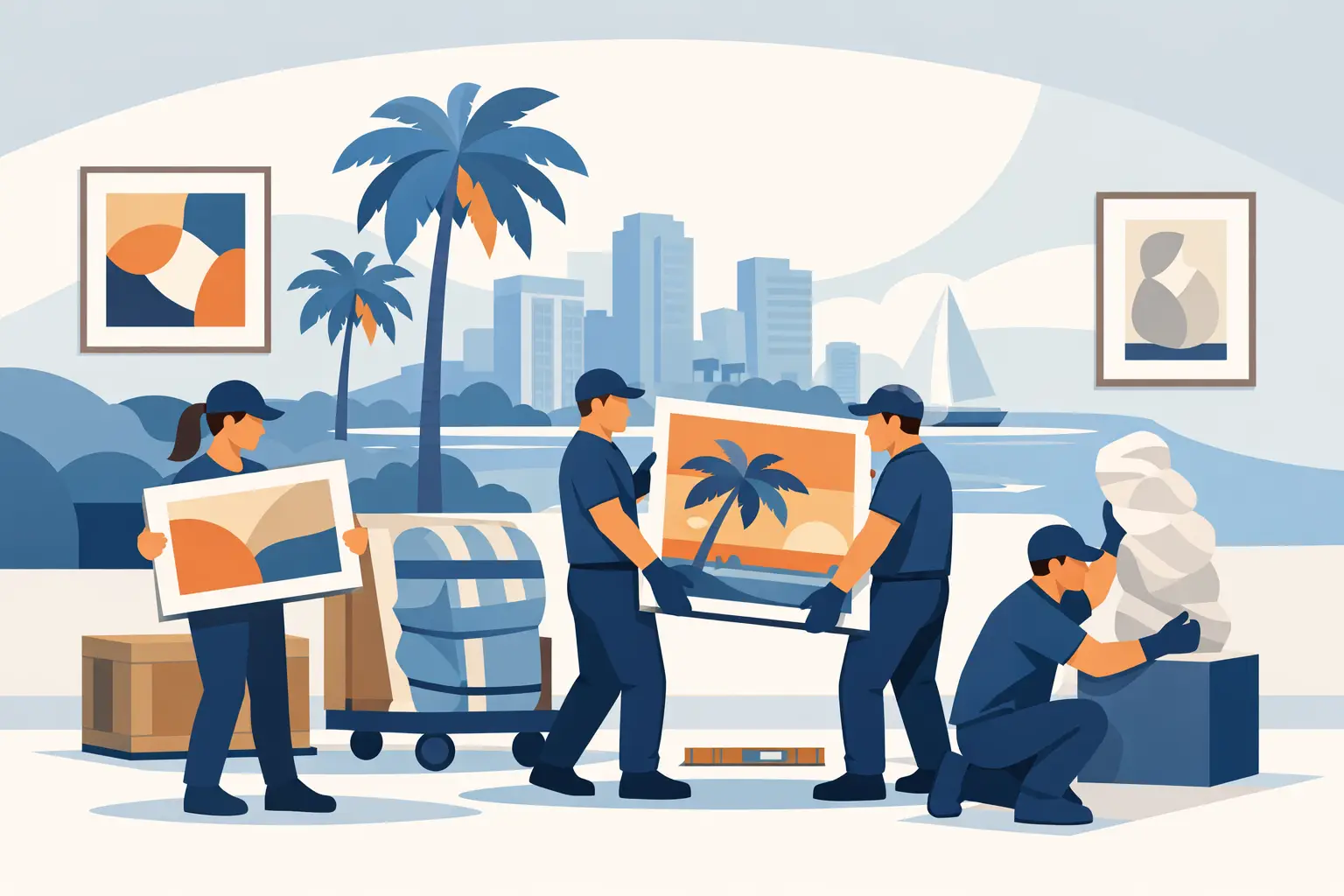
A sculpture arrives with a delicate patina, a framed work carries a vulnerable finish, and a large painting needs to clear a tight stair turn without a single point of stress. This is where south florida art handlers are judged – not by promises, but by process, control, and outcome. When the work is valuable, irreplaceable, or simply too significant to risk, professional handling is not an upgrade. It is the baseline.
In the fine art world, handling is rarely just about moving an object from one address to another. It involves assessing condition, understanding materials, anticipating environmental and structural risks, coordinating timing, and protecting presentation standards from pickup through final placement. For collectors, galleries, designers, and institutions, those details are what separate white glove service from generalized moving labor.
What South Florida art handlers actually do
Art handling includes the physical movement of artwork, but serious projects require much more than that. A qualified team starts with the piece itself – its medium, size, glazing, framing, age, vulnerability, and installation requirements. A framed photograph, a resin sculpture, and a monumental canvas do not travel or install the same way, even if they share a destination.
That difference matters in South Florida, where logistics can be unusually demanding. High-rise deliveries, narrow service corridors, coastal humidity, tight loading windows, and busy event calendars all affect how a project should be planned. In many cases, the challenge is not distance. It is control.
Professional art handlers also manage the chain of care around the work. That often includes condition reporting, protective wrapping, custom packing, crating when needed, secure transport, on-site coordination, and precise installation. For clients with multiple works or multiple locations, project management becomes just as important as the physical handling itself.
Why specialized handling matters for fine art
The risk with artwork is not limited to obvious breakage. Damage often shows up in quieter ways – frame corner compression, pressure to a canvas surface, vibration stress, abrasion during packing, hardware failure on install, or environmental exposure during staging. These are the kinds of issues that non-specialized crews may not recognize until the damage is already done.
The trade-off is straightforward. Standard moving services may appear faster or less expensive upfront, but they are built for furniture, household goods, and general freight. Fine art demands a different standard because value is not only financial. A work may be one of a kind, emotionally significant, historically relevant, or central to a collection’s presentation.
Specialized handlers work with that reality in mind. They know when to build support around a frame rather than place pressure on it. They know why surface sensitivity changes packing choices. They know that installation is not complete when the piece is on the wall – it is complete when placement, hardware, alignment, spacing, and site conditions all support long-term stability.
The qualities to look for in south florida art handlers
Experience matters, but experience alone is not enough. The right team combines technical handling knowledge with disciplined execution. Clients should expect a methodical approach, clear communication, and decisions based on the needs of the artwork rather than a one-size-fits-all workflow.
A strong art handling partner pays close attention during the assessment stage. That means asking the right questions before the job begins: What are the dimensions and materials? Is there existing condition documentation? Does the work require travel frames, soft packing, or a custom crate? Are there elevators, stairs, low-clearance entries, restricted delivery windows, or installation surface concerns? These details are not administrative extras. They are how risk is reduced.
Discretion is another marker of professionalism. High-value collections, private residences, gallery inventories, and commercial projects often require a quiet, controlled service model. The best handlers understand that confidentiality, punctuality, and site etiquette are part of the work.
Packing, crating, and transport are not interchangeable
Clients sometimes use these terms broadly, but they solve different problems. Packing refers to the protective materials and methods used to shield a work during movement or storage. Crating adds a higher level of structural protection, often necessary for fragile, high-value, oversized, or long-distance transport. Transport is the managed movement itself, with attention to secure loading, vehicle conditions, route planning, and handling at each transfer point.
It depends on the piece. Some works are adequately protected with careful soft packing and direct transport. Others require custom crating because even minor vibration, pressure, or environmental fluctuation could create unacceptable risk. The key is not choosing the highest level of intervention every time. It is choosing the right level for the artwork, the route, the schedule, and the destination conditions.
That tailored approach is especially important for mixed projects. A gallery relocation, a residential install, or a multi-piece delivery may include works with very different needs. Treating every piece the same can waste time in one area and create exposure in another.
Installation is where expertise becomes visible
Transport gets most of the attention, but installation is where craftsmanship becomes obvious. A poorly installed artwork can shift, strain, hang unevenly, or suffer damage long after the crew has left. This is why professional installation is not just about placement. It is about weight distribution, hardware selection, wall conditions, sightlines, spacing, and security.
For designers and collectors, presentation matters as much as protection. A piece may be perfectly transported and still fail the room if the height is off, the alignment is inconsistent, or the hardware does not suit the wall assembly. Museum level care includes both preservation and presentation.
This is where an experienced South Florida team brings real value. Residential towers, hospitality spaces, and commercial interiors often involve concrete, specialty wall finishes, access restrictions, and coordinated timelines with other trades. Art handlers who understand those variables can keep the installation precise without compromising the artwork or the site.
Who benefits most from professional art handling
Private collectors rely on professional handling when acquiring new work, rotating collections, moving residences, or preparing pieces for storage or display. Galleries and dealers need dependable execution across shipments, fair schedules, client deliveries, and exhibition turnover. Designers need installers who can match the finish level of the surrounding project and work cleanly within active job sites or completed homes.
Artists and studios also benefit, particularly when large-scale or fragile works are involved. The same is true for hospitality and commercial clients, where artwork often has to move through complex buildings and land exactly as planned. In each case, the common need is confidence – confidence that the work will be protected, the schedule will hold, and the final result will reflect the value of the piece.
What a well-run project should feel like
A high-level art handling project should feel calm. That does not mean simple. It means the complexity is being managed properly.
Clients should know what happens first, what protection method is being used, what the timing looks like, and who is responsible at each stage. They should not have to chase updates or explain basic art care principles on site. The team should arrive prepared, equipped, and fully aware of the scope.
That level of control is what builds trust over time. In Miami’s art community, reputation is shaped by consistency. ARTSOLVE’s approach reflects that standard: careful planning, museum-level handling, and execution that respects both the artwork and the client environment.
When selecting art handlers, the question is not simply who can move the piece. It is who can protect its condition, preserve its presentation, and manage the details without creating new risks. That is the difference clients feel immediately, and it is usually the difference they remember on every project after.
Need Help Installing Your Artwork?
From private residences to commercial and hospitality spaces, ART SOLVE provides professional art installation throughout Miami and South Florida, with the precision, care and experience valuable artwork demands.


