
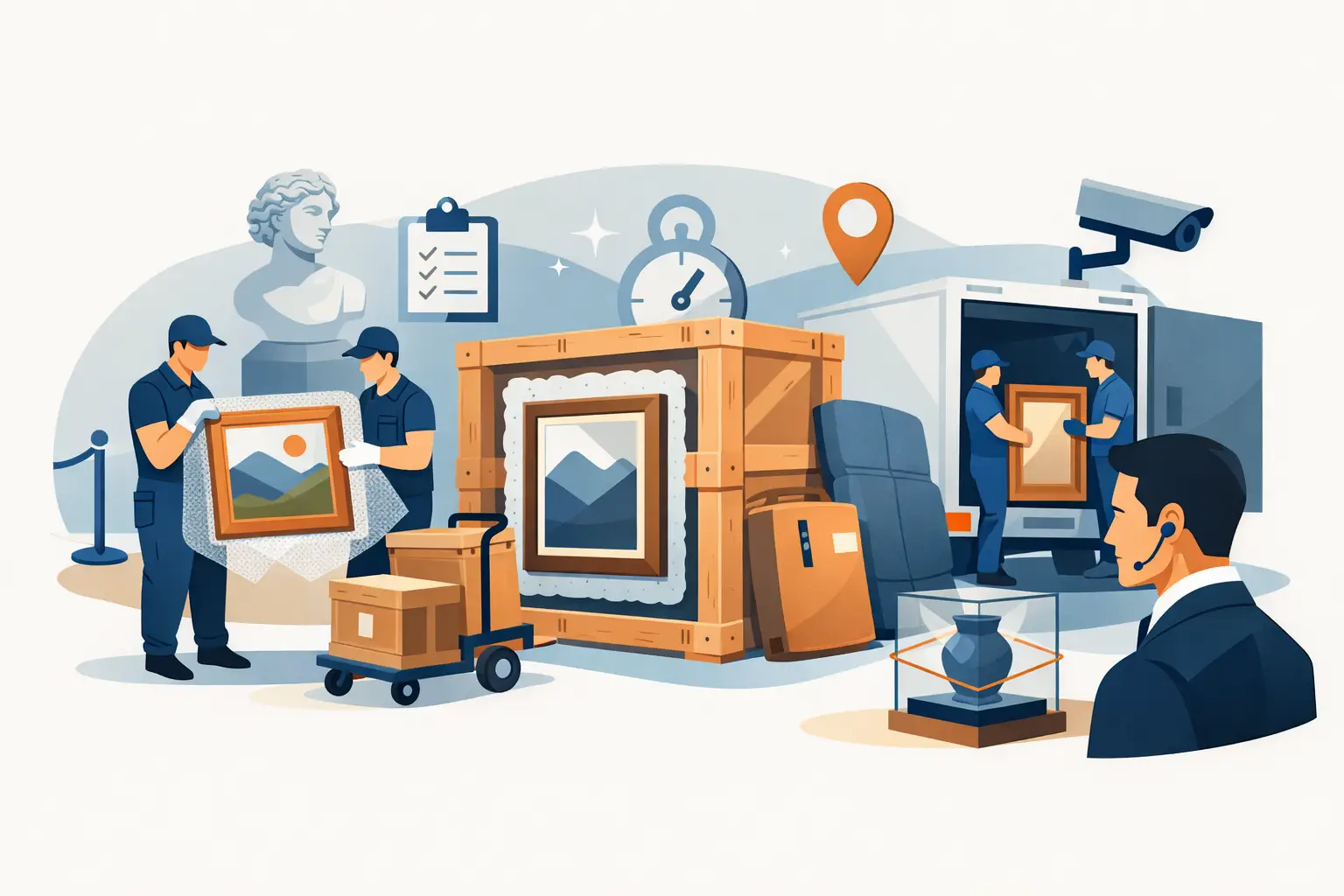
A late crate, a missing condition report, or a wall not ready for load can put an entire exhibition at risk. Museum exhibition logistics is the discipline that prevents those failures long before opening day, with careful planning around handling, transport, documentation, installation, and timing.
For museums, lenders, galleries, and private collections, logistics is not a back-office function. It directly affects conservation, presentation, insurance compliance, lender confidence, and the visitor experience. When the work is rare, fragile, oversized, or moving on a tight schedule, every handoff matters.
What museum exhibition logistics actually covers
Museum exhibition logistics includes much more than moving objects from one place to another. It starts with understanding the needs of each work, then building a handling plan around its material condition, dimensions, framing, packing requirements, travel risks, and installation method.
That often means coordinating condition reporting, custom crating, transport sequencing, courier support, receiving procedures, staging, lift and rigging access, installation schedules, deinstallation, and return routing. In many projects, the logistics plan also has to account for lender requirements, security protocols, climate considerations, and the realities of a live construction or exhibition calendar.
The operational challenge is that no two exhibitions are identical. A contemporary painting show with framed works on standard walls asks for one kind of workflow. A multi-venue exhibition with sculpture, media components, and borrowed works from several collections requires another. Good logistics is specific, not generic.
Why museum exhibition logistics starts before packing
The most common mistake in exhibition planning is treating logistics as something that begins once the checklist is final and the artworks are ready to move. In practice, the highest-value decisions happen earlier.
At the planning stage, teams should already be reviewing object lists, dimensions, weights, media, mount needs, site access, and target dates. If a work needs a travel frame, a custom crate, a forklift window, or a specialized installation crew, those details affect budget and timing from the beginning. Waiting too long compresses decision-making and increases risk.
This early phase is also where practical conflicts surface. A museum may want installation to happen in a narrow window, while lenders require extended acclimatization time. A designer may envision a placement that looks right on paper, but the wall substrate or anchor strategy may not support the load. Logistics professionals help resolve those issues before they become expensive surprises.
The chain of custody is part of the care standard
High-value artwork requires more than careful hands. It requires traceability. Every transfer point should be documented, from pickup through delivery, staging, installation, deinstallation, and return.
Condition reports are central here, but so are packing records, crate labels, location tracking, receiving notes, and sign-offs at each handoff. This documentation protects everyone involved. It provides clarity if a concern arises, and it establishes that the work has been managed according to professional standards.
For collectors and institutions, this level of control also reduces stress. There is a meaningful difference between knowing a piece is “on the way” and knowing exactly how it was packed, who received it, where it is staged, and what condition it was in at each stage.
Packing and crating decisions affect more than transport
Packing is often discussed as a transport issue, but in museum settings it affects scheduling, labor, environmental stability, and installation readiness. The right crate can reduce vibration, support climate buffering, and speed up safe handling on site. The wrong one can create delays before the art is even unwrapped.
Custom crating is especially important for vulnerable surfaces, unusual proportions, heavy sculptures, and mixed-media works. A crate should reflect the object, not a warehouse standard. Interior supports, soft packing materials, vapor barriers, hardware access, and opening orientation all matter.
There is also a trade-off to manage. Overbuilding can add cost, weight, and handling complexity. Underbuilding exposes the work to impact and movement. Experienced teams find the correct balance based on the piece, the route, the venue conditions, and whether the crate will be reused across multiple legs of travel.
Scheduling is where exhibitions are won or lost
Even well-packed artwork can become a problem if the schedule is unrealistic. Museum exhibition logistics depends on sequencing. The order in which works arrive, acclimate, stage, and install should match the physical realities of the space and the labor available.
For example, large works may need to move in before casework is finalized or before tight gallery pathways are blocked. Fragile objects may require quiet installation windows with limited foot traffic. Multi-venue loans may need coordinated arrivals to avoid overcrowded staging areas and rushed unpacking.
This is why serious exhibition logistics looks beyond a single delivery date. It maps lead times for crating, transport, courier coordination, site readiness, installation labor, and contingency. If one step slips, the rest of the schedule should not collapse with it.
Installation is part of logistics, not a separate afterthought
A recurring issue in exhibition planning is the assumption that transport and installation are distinct scopes with little overlap. In reality, the installation plan should inform how a work is packed, loaded, staged, and brought into the building.
A framed work headed to a standard hanging system is one thing. A monumental sculpture requiring lifts, floor protection, team handling, and exact placement tolerances is another. The route into the gallery, the orientation inside the crate, and the tools available on site all shape how smoothly the installation proceeds.
Museum-level care also means respecting the artwork in the final presentation stage. Precise placement, secure mounting, balanced sightlines, and clean handling are not cosmetic concerns. They are part of preserving the work and presenting it properly to the public.
The venue matters as much as the object
Every building introduces its own logistical constraints. Loading docks vary. Freight elevators have different capacities. Some sites allow direct gallery access, while others require long interior routes, protective floor coverings, and carefully timed deliveries.
Climate control is another variable. A museum may have stable environmental systems, but staging areas, temporary holding spaces, or shared back-of-house zones may not. That matters for sensitive materials and for works moving between different conditions.
In South Florida, weather exposure and humidity can complicate even short transport windows. That does not mean every move is high risk, but it does mean planning should account for climate transitions, vehicle loading strategy, and how long artwork is exposed during loading and unloading.
What clients should expect from a qualified logistics partner
Clients commissioning an exhibition should expect operational clarity, not vague assurances. A qualified partner should be able to explain how each artwork will be assessed, packed, documented, transported, staged, and installed. They should ask informed questions early and identify concerns before the schedule is under pressure.
They should also understand that discretion is part of the service. Many projects involve private collections, confidential lender arrangements, active construction sites, or high-profile openings. Professionalism includes protecting information, controlling access, and communicating with precision.
For this kind of work, experience in fine art handling matters more than general moving capacity. Museum exhibition logistics requires people who understand fragility, presentation standards, and the consequences of small errors. ARTSOLVE approaches that responsibility with white glove handling, technical discipline, and respect for the artwork at every stage.
A strong exhibition depends on invisible work
Visitors see the lighting, the spacing, the wall text, and the objects exactly where they belong. What they do not see is the planning that made that calm experience possible. The crate design, the route survey, the condition review, the timed delivery, the protected staging area, the exact hardware, and the installation sequence all sit behind the scenes.
That invisible work is where trust is built. It protects the artwork, supports the institution, and gives lenders and collectors confidence that their pieces are in capable hands. When museum exhibition logistics is done well, the exhibition feels effortless. That is usually the clearest sign that the hard part was handled properly from the start.
Need Help Installing Your Artwork?
From private residences to commercial and hospitality spaces, ART SOLVE provides professional art installation throughout Miami and South Florida, with the precision, care and experience valuable artwork demands.


