
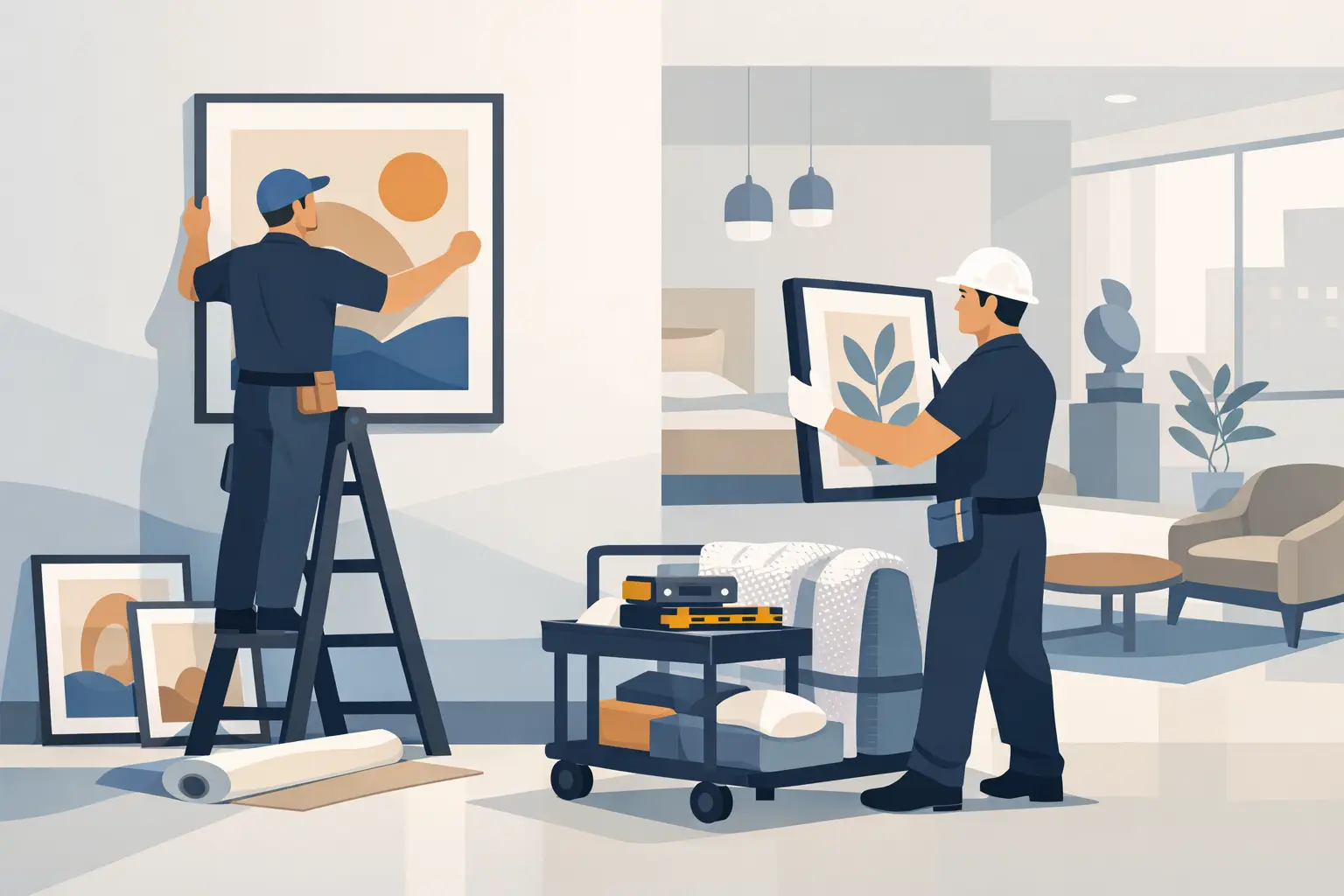
A hotel opening rarely gets delayed because the artwork arrived late. It gets delayed because the last 10 percent – receiving, condition checks, placement decisions, wall prep, hardware, coordination with trades, and final install – was treated like an afterthought. Hotel art installation services exist to prevent that exact scenario.
In hospitality, art is not decorative filler. It shapes first impressions in the lobby, supports the identity of a guest room program, creates moments in corridors and public spaces, and often becomes part of the property’s visual signature. But the more visible the artwork, the higher the stakes. A poorly aligned framed piece, an unstable sculpture base, or damage during receiving does more than create a punch-list item. It affects brand presentation, guest safety, and the long-term condition of the collection itself.
What hotel art installation services actually cover
Many hospitality teams use the phrase broadly, but the work is more specialized than standard delivery or general mounting. Proper hotel art installation services typically begin well before anything reaches a wall. The process includes receiving, condition reporting, inventory verification, short-term storage when needed, transport to site, coordination with designers and project managers, and final installation using methods appropriate to both the artwork and the environment.
That distinction matters. Hotels are complex operating spaces, not blank galleries. An installer may be working around active construction, soft opening deadlines, occupied floors, elevator restrictions, life-safety requirements, and brand standards that leave little room for improvised decisions. Museum-level handling is not excessive in this setting. It is often the only standard that makes sense.
Some projects are highly uniform, such as guest room packages with repeated framed works across dozens or hundreds of keys. Others are mixed and more demanding, with custom commissions, oversized lobby pieces, wall-mounted sculptural elements, and fragile works requiring specialized hardware or lift access. The right service partner can handle both, but the planning approach should change based on the collection.
Why hospitality projects require a different installation standard
A private residence allows for more flexibility. A gallery exhibition can be controlled closely. A hotel is different because aesthetics, durability, public access, and operations all intersect.
Artwork in hospitality settings must present well under constant use. Pieces installed in guest corridors, elevators, lounges, restaurants, and meeting spaces are exposed to vibration, cleaning activity, luggage traffic, shifting humidity, and frequent proximity to the public. Installation methods need to account for these realities without compromising the visual intent of the design.
There is also the issue of scale. Installing twenty pieces in a boutique property is one thing. Installing hundreds across multiple floors is another. The risk profile changes quickly when inventory grows. Without disciplined labeling, room-by-room staging, clear sequencing, and condition documentation, mistakes compound fast. Pieces end up in the wrong locations, packaging gets discarded too early, and damage attribution becomes harder to track.
That is why experienced hospitality art teams place so much emphasis on process. Precision is not just about how the final piece hangs. It is about how every decision before installation protects schedule, accountability, and the artwork itself.
The planning stage determines whether installation day goes smoothly
The strongest hotel art installations are usually quiet from the client’s perspective. That calm outcome comes from extensive preparation.
Before installation begins, the artwork should be assessed for medium, size, fragility, glazing type, hanging requirements, and any special handling concerns. A heavy framed work may require blocking confirmation or specialty anchors. A sculpture may need a custom mount or pedestal stabilization. A multi-piece series may need exact spacing templates approved in advance. None of this should be left to field guesswork.
Site conditions matter just as much. Teams need to know whether walls are finished, whether touch-up painting is complete, whether access routes are clear, and whether other trades will still be active during the install window. In hotels, sequencing can make or break efficiency. It is far better to coordinate with the larger construction or renovation schedule than to force installation into a site that is not truly ready.
This is also the point where documentation becomes essential. Receiving logs, condition reports, placement schedules, and installation maps reduce confusion and give ownership, designers, and operators a shared record of what arrived, what was installed, and where each piece belongs.
Where projects tend to go wrong
Most hotel art issues are preventable, but they happen when the work is treated as simple labor instead of specialized art handling.
One common problem is using general movers or maintenance teams for fine art receiving and placement. They may be capable with furniture or fixtures, but artwork carries different risks. Pressure on frame corners, incorrect unpacking, poor stacking, and rushed mounting can create damage that is immediate or only becomes visible later.
Another issue is inadequate packaging and crating before the art even reaches the property. If the works arrive without proper protection, installation teams inherit unnecessary risk. Good installation service starts upstream, with packing methods appropriate to each piece and transport conditions that support safe arrival.
There is also a coordination gap that shows up often in hospitality work. Designers, procurement teams, hotel operators, and installers may all be working from slightly different documents. When that happens, even a careful team can lose time resolving conflicts over placement, height, orientation, or room assignments. A qualified partner closes those gaps early rather than reacting to them on site.
What to look for in a hotel art installation partner
Technical skill is the baseline. The stronger differentiator is operational judgment.
A serious provider should understand artwork as an asset, not merely a finishing detail. That means condition awareness, material sensitivity, disciplined handling, and the ability to match installation methods to the piece. It also means understanding the practical demands of hospitality environments, where artwork must hold up visually and physically over time.
Project management capability is equally important. Hotels involve many moving parts, and art installation sits at the intersection of design, logistics, and operations. A reliable team communicates clearly, works from verified inventories, stages efficiently, and adapts when site conditions shift. They do not create extra supervision for the client.
Discretion matters too, particularly for luxury properties, custom commissions, and high-value collections. Hospitality clients often need a team that can work professionally in active environments, coordinate with ownership representatives and designers, and maintain a polished presence throughout the process.
In South Florida, local knowledge can also make a meaningful difference. Building access, weather exposure, coastal conditions, and the pace of hospitality projects all affect execution. A company such as ARTSOLVE, with experience in Miami’s art and design ecosystem, brings practical familiarity that can help projects move with more control.
The value of white glove handling in hotels
White glove handling is sometimes mistaken for a luxury add-on. In reality, it is a risk-control standard.
For hotels, the cost of artwork damage is rarely limited to restoration or replacement. There may be schedule disruption, designer dissatisfaction, opening delays, brand presentation issues, and safety concerns if the installation itself is compromised. White glove handling addresses those risks through trained art handlers, appropriate packing and crating, careful transport, and precise installation methods.
It also supports consistency. In a hotel setting, consistency is part of quality. Artwork should be level, centered correctly, installed at approved heights, and aligned with the design intent across every floor and room type. That level of finish requires more than manpower. It requires method.
Hotel art installation services and long-term asset care
Installation is not the end of the artwork’s lifecycle in a hotel. It is the start of its life in service.
That is why the best hotel art installation services consider maintainability from the beginning. Works in high-traffic areas may need more secure hanging systems. Pieces near direct sunlight, humidity shifts, or food and beverage activity may require different placement strategies. Staff should know when not to move a work, how to report damage, and who to call if a piece needs to be removed for renovation or repair.
For hospitality groups managing multiple properties, this becomes even more important. Standardized documentation, inventory control, and condition tracking make future rotations, refreshes, and relocations easier to manage. The artwork remains an organized asset rather than becoming an operational headache.
Hotels invest heavily in finishes, lighting, and furniture because those elements shape guest experience. Art deserves the same level of seriousness. When it is handled with precision from receiving through final placement, it supports the property exactly as intended – visually, operationally, and over time.
If a hotel art program matters enough to specify, source, and insure properly, it matters enough to install with the same level of care.
Need Help Installing Your Artwork?
From private residences to commercial and hospitality spaces, ART SOLVE provides professional art installation throughout Miami and South Florida, with the precision, care and experience valuable artwork demands.


